

Succeed in the ultra-high-resolution 3D scenography image transmission
with two non-compressed full-resolution 8K video streams
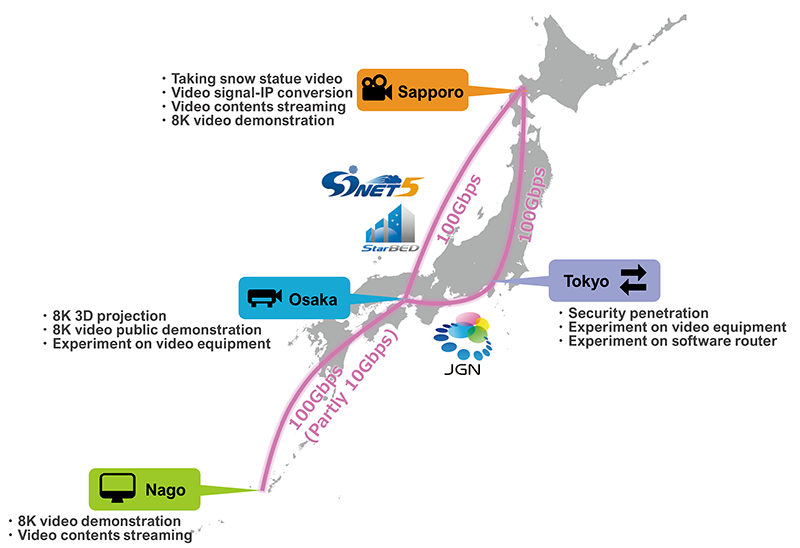
In February 2020, NICT ICT Testbed Research and Development Promotion Center conducted the video streaming demonstration experiments using images of Sapporo Snow Festival and professional baseball camp on JGN testbed. Total of 57 organizations from industry, academia and government including NICT took part in the experiments and brought expertise such as technology, human resources and equipment. The experiments were conducted in Sapporo, Tokyo, Osaka and Okinawa.
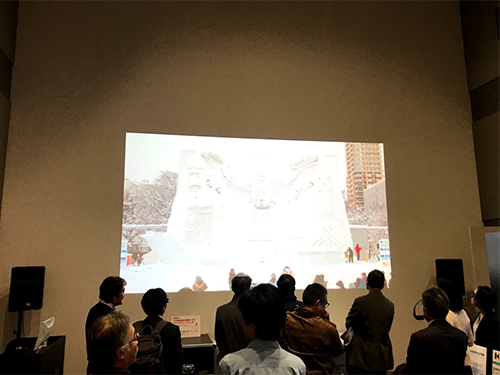
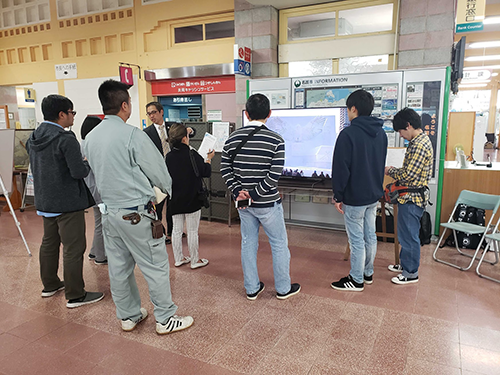
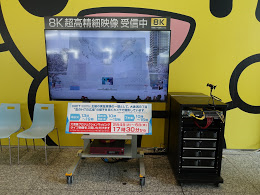
On February 5th and 6th, we demonstrated 8K ultra-high definition 3D video (stereoscopic video) and 8K video transmission projecting to a theater projector with 37,000 lumens (pre-released product) at the venue in Osaka (The Lab. in Grand Front Osaka building). From February 4th to 7th, public viewing sites of 8K UHD (ultra-high definition) video were set up in Sapporo at Hokkaido Television Broadcasting Corporation (HTB) and at Nago City Hall in Okinawa.
Overview
We have been conducting video streaming demonstration experiment using various advanced technologies in relation to communications, broadcasting, video streaming and related technologies every year.*1
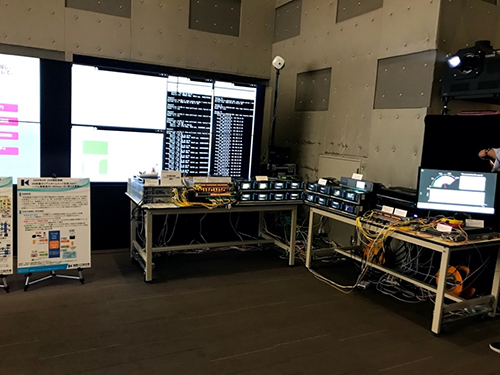
This year, we conducted a trial of synchronizing two full-resolution 8K non-compressed video streams and play them back as 3D video, a demonstration experiment of advanced communication technology such as transmission using software 100Gbps router on PC and a verification of cyber defense performance of video and communication equipment. Each participating organization brought in their technical issues and collaborated the experiments on variety of themes.
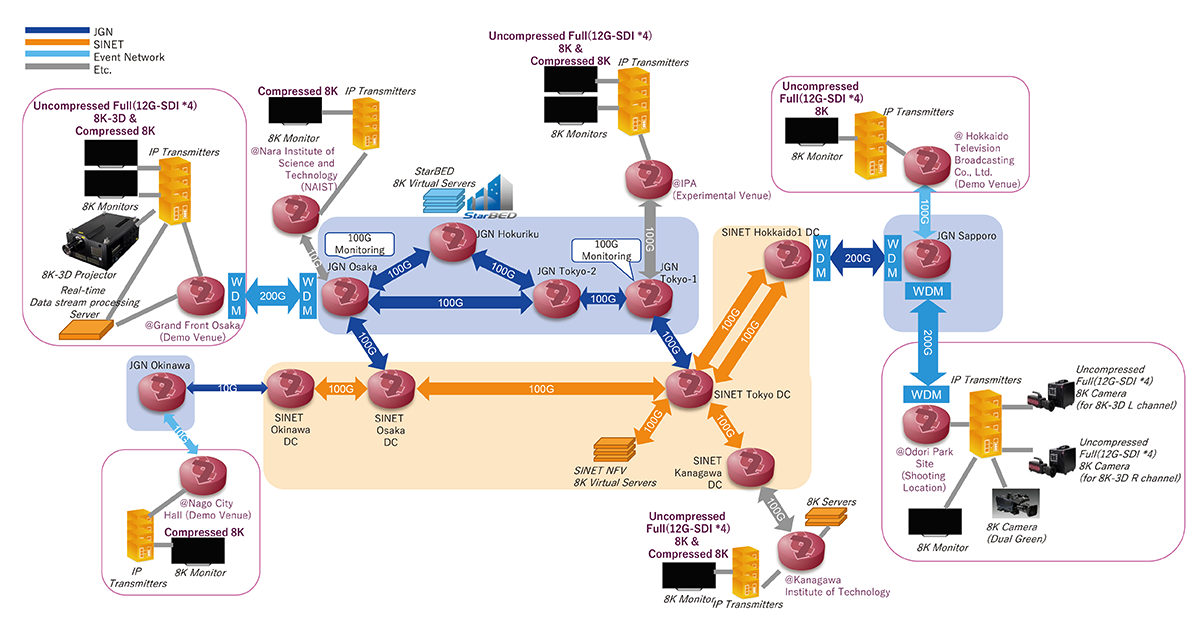
In this experiment, JGN, ultra-high-speed R&D network testbed operated by NICT was in collaboration with SINET5 R&E network operated by NII to establish two independent 100Gbps lines between Sapporo and Osaka and it made possible to reproduce ultra-high precision 3D images. In addition to this, thanks to the local networks for their cooperation which made possible to conduct public viewing of the demonstration at the local sites.
| *1: | Since 2004, we have been conducting the video streaming demonstration experiments in February every year. We have built realistic experimental sites as close as the actual production environment from the scratch. We also used StarBED, Large Scale Emulation Testbed which is also provided by NICT together with JGN to process 8K non-compressed video images. |
● Broadcasting and Video Technologies
1) Streaming of 3D videos with full resolution non-compressed 8K videos
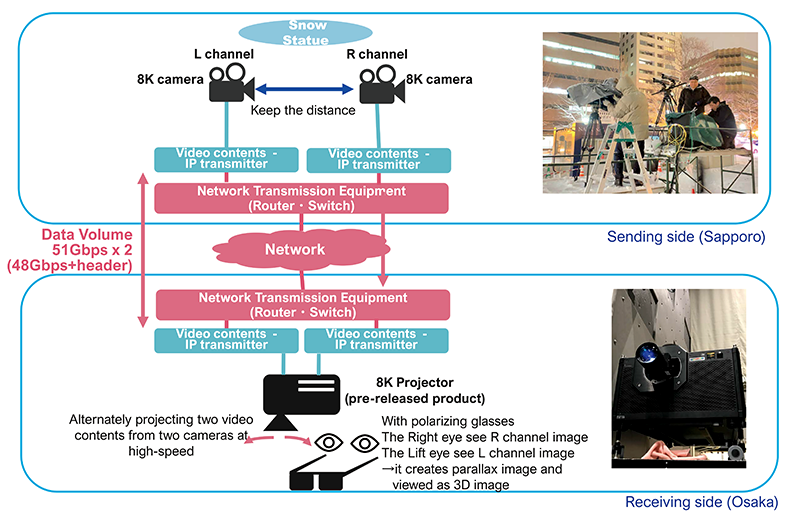
In recent years, the focus of 8K video imaging technology has shifted to products with added values and realistic sensations. This year, we remotely transmitted full-resolution 8K video without compression and reproduced 3D video to the projector. Because 8K video has 16 times higher spatial resolution (7680x4320) than high-definition video, instead of using the conventional dual-green method (8K-DG), we used the full-resolution 8K video (YUV4:2:2:10 bit) technology in this experiment which is for very high image quality. To transmit this over IP without compression, a bandwidth of 48Gbps per one video material is needed (because of the header overhead, approximately 51Gbps bandwidth per one video material is required in this experiment for the transmission).
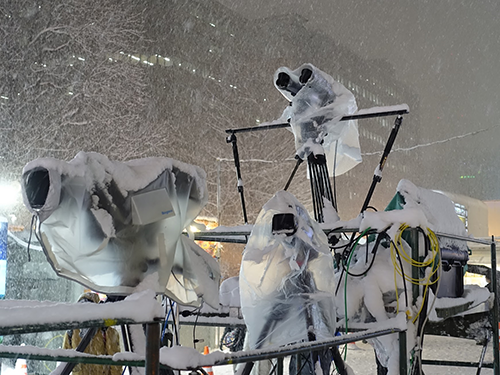
This time, because it requires left (L) and right (R) channels for 3D projection, we installed two 8K full-resolution cameras in front of the snow statue to take the videos. The locations of the two cameras are calculated from the parallax angle and the distance from the statue. The bandwidth when transmitting from the camera is 51Gbps, therefore, we built two 100Gbps lines from the site in front of snow statue to the demonstration site in Osaka and in some sections Wavelength Division multiplexing (WDM) is used. The L channel and R channel videos are transmitted through different physical paths with different propagation delays and synchronize them to prevent image misalignments due to the delay deference during the playback at the receiving side.
The projector at the receiving side uses a frame sequential method to project 120-frame-per-second video generating from L and R channels alternately (60p*2 for each channel and total 120p). The audiences wear polarized glasses to view 3D video images.
| *2 60p: | 60 frames per second progressive scan |
2) High-speed video switching with 8K video real-time edge processing
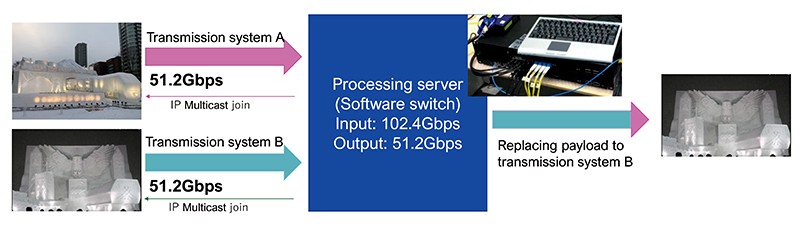
A large capacity real-time edge processing experiment was conducted on a general-purpose machine which has network switching functions (developed by Kanagawa Institute of Technology) and demonstrated switching two full-resolution 8K video materials (51Gbps each) at high speed. The machine uses DPDK (Data Plane Development Kit) and replacing the payload section of IP packet in order to switching videos at the minimum time.
3) Compressed 8K video streaming and high-precision time synchronous distribution
It is essential to compress the data when video streams on broadcast waves or in the environments with limited communication bandwidth. We conducted verification experiments of equipment with different compression ratios and transmission options, assuming various environments and usage, such as transmissions between the local broadcast stations and on-the-spot broadcasting as well as broadcasting waves. From the experiments, we have clarified several necessary improvements in design and protocol implementations under the specific conditions.
Moreover, with the introduction of IP in the field of video production and distribution, high precision time synchronization (Precision Time Protocol (PTP)), which enables time synchronization at less than microsecond on the network, became a very important technology.
A Global Navigation Satellite System (GNSS) antenna is installed as a time source at each experimental site, and PTP and Black Burst (BB) signals are generated by PTP Grandmaster Clock (PTP GM) with GNSS as the time source. We delivered PTP and BB from PTP GM and conducted long distance distribution experiments with 8K resolution Video Over IP while the experimental equipment’s time was synchronized by GNSS.
4) Ultra-Realistic Acoustic Environment Reproduction Technology
For fulfilling Ultra Reality, audio also becomes a very important element. In this experiment, we have collaborated with WIDE Project working group, SDM (Software Defined Media) and conducted trials for ultra-realistic sound precision space synthesis.
● Demonstration experiment of advanced communication technology
◦Kamuee: High speed software routing engine
For full 8K resolution non-compressed streaming 3D video distribution, we installed Kamuee, which NTT Communications Corporation has been developing as a high-speed software routing engine running on PCs, on L channel video communication path and conducted series of experiments and demonstrations. The experimental environment has various network equipment such as routers which consists JGN backbone network and it shown that Kamuee can be in practical use even for more than 50Gbps real-time data multicast streaming. In addition to this, Kamuee’s traffic observation function played an active role in troubleshooting during the experiments. The Kamuee development team and their participation made the experiments successful.
● Verification of anti-cyber defense performance
◦Security penetration testing in video distribution networks
At this experiment, following the last year, under the initiative of Information Promotion Agency (IPA) Industrial Cyber Security Center of Excellence, members of the Industrial Cyber Security Advanced Human Resource Development Program have conducted various penetration tests and discovered several zero-day vulnerabilities which are not yet identified at the time of the experiment or no fixed program has existed. These results are fed back to the participants of the experiments and contributing to enhance software and equipment security.
About the experiments
Under the auspices of NICT, companies, universities and research organizations have participated in this project, with a common goal of demonstrating the latest technological challenges. On that basis, according to individual challenges of each participating organizations, they brought together equipment, products and software that are under development and deeply involved from the design stage of the experiments. This made possible to build an environment with the various devices the same as the actual network operation.
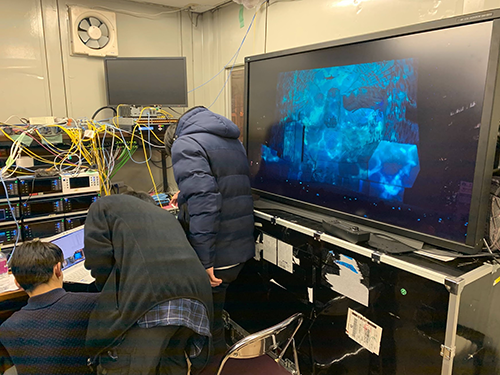
The experiment was conducted by members of participating organizations in Sapporo, Tokyo, Osaka and other locations, and the experimental software was modified at each venue, and the hardware and firmware were being updated. This have become a valuable venue for sharing the technical knowledge among researchers, engineers and students through practicing of actual constructions and operations, as well as the development of human resources.

- National Institute of Information and Communications Technology(NICT)
- Hokkaido Television Broadcasting Co., Ltd.
- GAORA INCORPORATED
- MAINICHI BROADCASTING SYSTEM, INC.
- NTT Communications Corporation
- NTT TechnoCross Corporation
- Nippon Telegraph and Telephone West Corporation
- KDDI CORPORAION
- Hokkaido Telecommunication Network Co.,Inc. (HOTnet)
- KYOWA EXEO CORPORATION
- OBIS CO., LTD. (OBIS)
- Trust Communication Inc.
- Fatware Inc.
- Arista Networks Japan Limited.
- FXC Inc.
- Keysight Technologies
- Cisco Systems G.K.
- Juniper Networks, Inc.
- Palo Alto Networks, Inc.
- Fortinet, Inc.
- NEC Corporation
- NEC Networks & System Integration Corporation
- Seiko Solutions Inc,
- Tohoku Information Systems Company, Incorporated
- FURUKAWA NETWORK SOLUTION CORP.
- Sharp Corporation
- ASTRODESIGN, Inc.
- Alpha Code Inc.
- IKEGAMI TSUSHINKI CO.,LTD.
- VILLAGE island Co., Ltd.
- AIM Electronics Co., Ltd.
- Embrionix
- KEISOKU GIKEN Co., LTD
- Servants International Corporation
- T-SPRTS Co., Ltd.
- TECHNO HOUSE INC.
- Digital Research Corporation
- PacketLight Networks Ltd.
- Hibino Corporation.
- PurelogicCO., LTD
- FUJIFILM Corporation
- Micro Research Ltd.
- Miharu Communications Inc.
- Kanagawa Institute of Technology
- Kyoto Sangyo university
- Keio University
- Daido University
- Tokyo University
- Nara Institute of Science and Technology
- National Institute of Informatics
- Information-Technology Promotion Agency, Japan
- Nago City, Okinawa pref.
- Union-wide Municipal Affairs of Northern Area of Okinawa Prefecture
- Nago Development Authority
- Knowledge Capital Association
- VisLab OSAKA
- Cyber Kansai Project (CKP)
- WIDE Project
IPA ICSCoE REPORT Vol.6 / page2
<Article Title *3>
The Alumnus–Trainee Collaboration Team Participated in A Video Transmission Experiment of the "Sapporo Snow Festival 2020"
| *3 : | The article is at the bottom left of the second page |

ICT Testbed Research and Development Promotion Center
E-mail: tb-info[at]ml.nict.go.jp